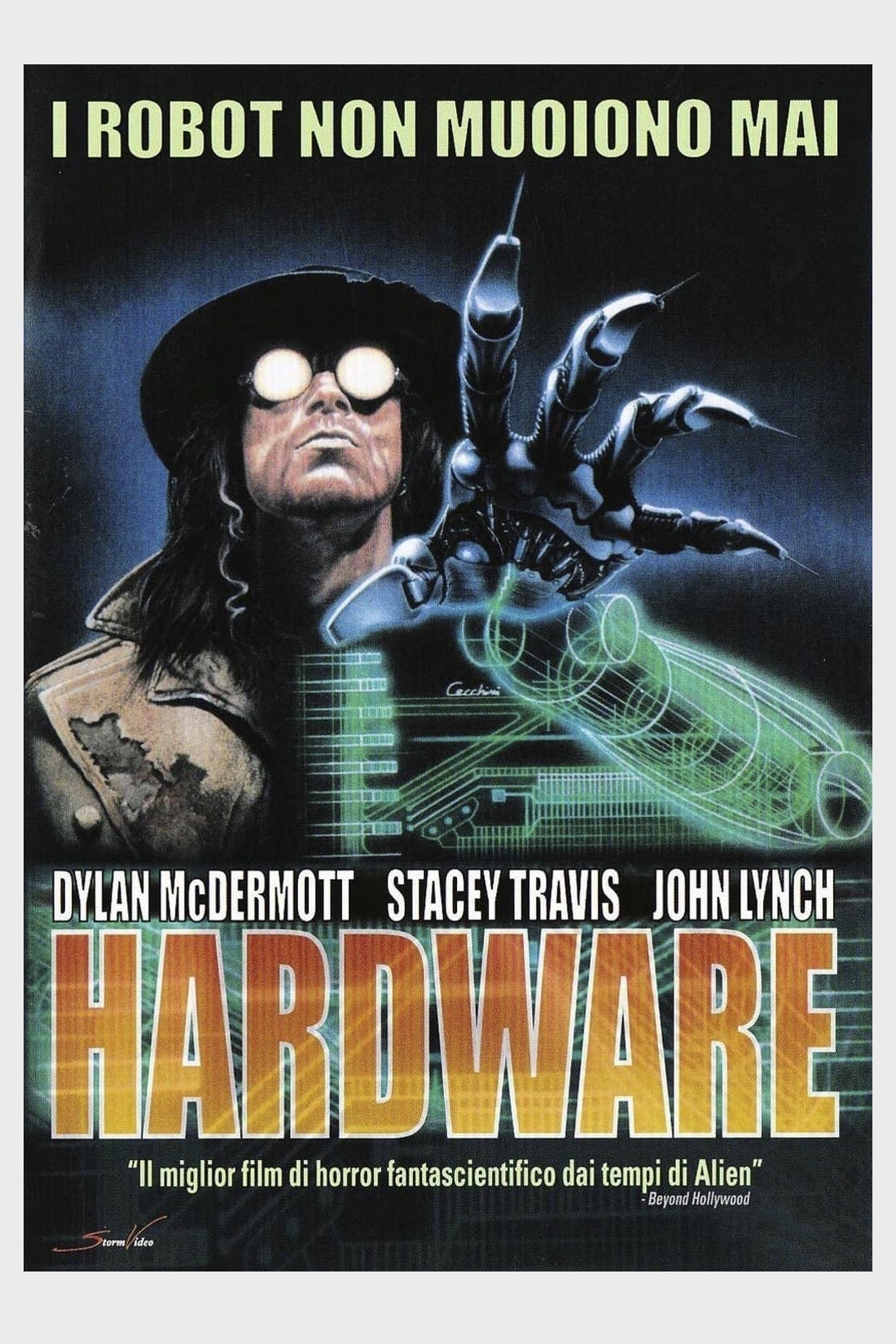
A Grim, Neon-Drenched Cyberpunk Nightmare
Step into the scorched, radioactive colon of the near future, where the sun is a dying orange ember and humanity is just a bad joke waiting for a punchline—the perfect, desolate setting for Richard Stanley’s Hardware. This celluloid fever dream follows Moses, a shell-shocked desert scavenger who brings home a twisted, American-flag-painted cybernetic skull for his reclusive metal-sculptor girlfriend, Jill, hoping to buy a moment of tenderness in a world that has run entirely out of soul. But the junk is actually the self-assembling skull of the M.A.R.K. 13, a government-sanctioned military droid programmed for population control with the absolute, genocidal directive: “No flesh shall be spared.” What begins as a gritty, post-apocalyptic domestic drama quickly devolves into a claustrophobic, “space-age nightmare” as the droid reconstructs itself inside Jill’s high-security apartment, transforming her sanctuary of art into a neon-drenched abattoir where the biological and the mechanical wage a desperate war of attrition.
The manic, visceral energy of this claustrophobic nightmare is driven by a crew of beautifully deranged conspirators. Writer-director Richard Stanley, a visionary who would later helm the mystical cult horror Dust Devil and the hallucinatory H.P. Lovecraft adaptation Color Out of Space, infuses the film with a music-video aesthetic that feels like a bad trip in an industrial nightclub. Stacey Travis delivers a fierce, physically demanding performance as Jill, bringing a grounded vulnerability to the screen before moving on to key roles in Steven Soderbergh’s Traffic and the indie darling Ghost World. Dylan McDermott channels a rugged, desperate machismo as the doomed Moses, a role that preceded his rise as a mainstream television force in The Practice and his twisted turns in American Horror Story. Behind the camera, cinematographer Steven Chivers paints the screen in suffocating, infrared reds and toxic yellows, while the production is elevated by counter-culture icons, including Motörhead’s Lemmy Kilmister as a cynical water-taxi driver and Iggy Pop as “Angry Bob,” the manic, screaming radio DJ who serves as the film’s prophet of impending doom.
Decades after its budget-strained birth, Hardware stands as a towering, prophetic monument of cyberpunk cinema, a low-budget scream against the corporate surveillance state and autonomous warfare that feels terrifyingly relevant today. While mainstream Hollywood was busy polishing high-tech, sanitized futures, Stanley offered a gritty, Giallo-soaked warning of technological hubris, marrying high-concept film theory with the raw, visceral poetry of a midnight movie. Its legacy lives on in the DNA of modern technophobic horror—a dirty, industrial classic that proved you do not need a hundred million dollars to capture the terrifying, metallic crunch of the future, only a camera, a nightmare, and the courage to look directly into the red, glowing eye of the machine.
VHS RIP from Archive.org