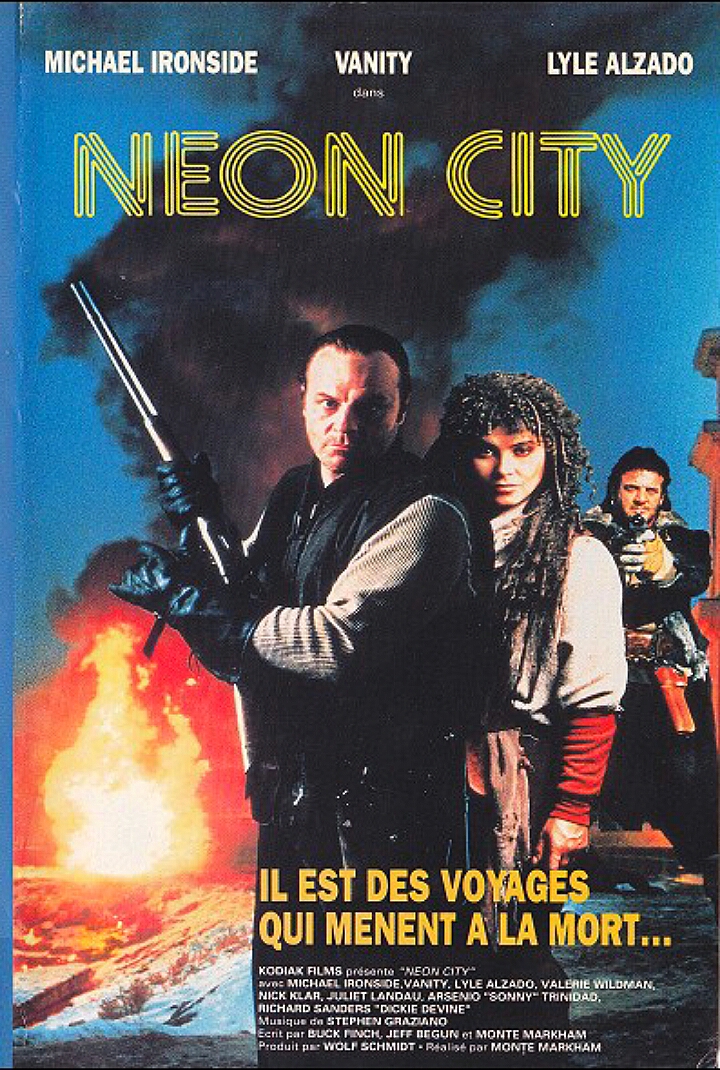
Strap your mind to the armored chassis of a heavily modified transport bus and prepare for the freezing, radiation-cooked highway of Monte Markham’s Neon City (1991). Set in a desolate 2053 where a catastrophic environmental experiment has permanently stripped the ozone layer, humanity is reduced to scattered, lawless settlements operating under the grim, roadside promise: “In the Year 2053, the ultimate escape is a ride on the bus to hell!” The narrative follows Harry Stark, a cynical, ponytailed former cop turned wasteland bounty hunter who has finally nabbed a high-value, “red star” fugitive named Reno. To cash in on his bounty, Stark must transport her from the border town of Jericho to the protected, indoor utopian stronghold of Neon City, forcing them to board a heavily armored, multi-passenger truck. The story arc unfolds as a tense, claustrophobic road trip through a ruined wilderness, where our mismatched travelers must survive radioactive “Xander clouds,” sudden 150-degree heatwave bursts called “brights,” and relentless assaults from skinless mutant raiders.
Michael Ironside’s Forgotten Post-Apocalyptic Masterpiece
The director steering this dusty, post-apocalyptic road trip is actor-turned-director Monte Markham, a versatile performer who directed Defense Play (1988) and appeared in television classics like The Second Hundred Years (1967–1968) and Baywatch (1989–1992). The legendary, gravel-voiced Michael Ironside anchors the vehicle as the flinty, ex-cop bounty hunter Harry Stark, delivering the trademark, hard-boiled charisma that defined his iconic villainous roles in sci-fi classics like Scanners (1981), Total Recall (1990), and Starship Troopers (1997). He is co-starred by Prince’s late, magnetic protégé Vanity as the fiercely defiant fugitive Reno, bringing her raw, physical allure to the screen after starring in 80s action favorites like The Last Dragon (1985) and Action Jackson (1988)[4][7]. Former NFL defensive lineman Lyle Alzado delivers a wonderfully gruff, heroic final performance as the transport driver Bulk, a physical role completed shortly before his tragic passing after minor turns in Club Fed (1990) and Destroying Angel (1990). Alongside them, Richard Sanders, Valerie Wildman, and a young Juliet Landau round out a colorful passenger list, while cinematographer Keith Holland captures the bleak, snow-dusted Northwest wastes to give the film a cold, uniquely grim atmosphere.
Why Neon City (1990) Is the Ultimate Cyberpunk Remake of John Ford’s Stagecoach
Over three decades after it first rolled onto mom-and-pop video store shelves, Neon City holds a uniquely respected, highly treasured place in the pantheon of post-apocalyptic cult cinema. While lazy observers frequently dismiss it as a standard Mad Max rip-off, film scholars and grindhouse purists celebrate it as an incredibly clever, sci-fi reimagining of John Ford’s classic western Stagecoach (1939), trading outlaws and Apaches for mutants and ecological disasters. The film elevates itself far above its low-budget peers through its surprisingly deep character development, its unique environmental hazards like the ultraviolet “brights,” and its refreshing shift from scorched deserts to frigid, snow-dusted landscapes. Today, it stands as a spectacular, adrenaline-fueled time capsule of the early 90s direct-to-video boom—a gritty, smart, and beautifully acted road-trip classic that proves even at the end of the world, character development and a solid screenplay still matter.
Watch on YouTube – GEM Film Library Channel