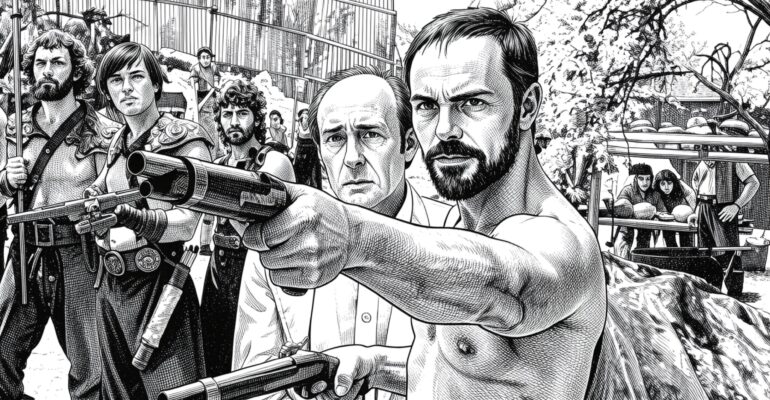
Strap yourself into a matter transmitter and prepare to plunge headfirst into the cardboard-and-synthetic-fur abyss of Terry Marcel’s Prisoners of the Lost Universe (1983). In a parallel, primeval world where giant rubber monsters roam the forests and the local cavemen are more hostile than a bad hangover, survival operates under the classic B-movie warning: “Sucked into a parallel universe, their only hope is to fight their way back to reality!” The narrative follows Carrie Madison, a tough TV host, and Dan, a rugged martial artist-electrician, who accidentally get sucked into an experimental matter transporter invented by an eccentric scientist. Deposited into the prehistoric fantasy dimension of “Vonya,” our mismatched pair is immediately hunted by primitive tribes, cave giants, and a ruthless, sword-wielding warlord named Kleel, who has managed to build an empire using modern technological scraps. The story arc unfolds as a frantic, campy escape mission across a wilderness of painted backdrops, where our heroes, allied with a clever dwarf thief named Malachi, must overthrow Kleel’s tyranny to secure the ruins of the portal and punch their ticket back home.
Terry Marcel’s Forgotten Fantasy Classic
The general steering this low-budget, fantasy-adventure joyride is director Terry Marcel, a capable British genre craftsman who directed the cult sword-and-sorcery classic Hawk the Slayer (1980) and the action-packed Jane and the Lost City (1987). Richard Hatch stars as the stoic, physical protagonist Dan, delivering a heroic, muscle-bound performance that came hot on the heels of his legendary, Emmy-nominated run as Captain Apollo in the original Battlestar Galactica (1978–1979) and his work on The Streets of San Francisco (1976–1977). He is flanked by the magnetic Kay Lenz as the resilient Carrie Madison, bringing a sharp, charismatic presence to the screen after starring in Clint Eastwood’s Breezy (1973) and the cult revenge thriller White Line Fever (1975). The incomparable John Saxon steals every frame he is in as the flamboyant, eyeliner-wearing villain Kleel, a powerhouse physical performance that fits perfectly alongside his legendary turns in Bruce Lee’s Enter the Dragon (1973) and Wes Craven’s A Nightmare on Elm Street (1984). Behind the camera, Marcel’s crew relies on incredibly charming, pre-CGI practical creature effects, utilizing painted backdrops, rear projection, and a bouncy, synth-heavy score by Harry Robertson to turn a South African quarry into a wild, highly atmospheric fantasy wasteland.
Why Prisoners of the Lost Universe (1983) Is the Ultimate 80s Sword-and-Sorcery Gem
Over four decades after its televised premiere on Showtime, Prisoners of the Lost Universe stands as an incredibly charming, highly respected monument to the 1980s sword-and-sorcery boom. While critics of the era frequently dismissed it as a cheap cash-in on Conan the Barbarian or Flash Gordon, modern film scholars and midnight-movie purists celebrate the film for its raw, unfiltered commitment to fantasy world-building, its magnificent, pre-digital practical effects, and its stellar cast of beloved genre icons. It remains an essential cult classic, celebrated for its wonderfully clunky dialogue, its rubbery beast suits, and John Saxon’s completely unhinged, scenery-chewing villainy. Today, the film serves as a spectacular, nostalgia-fueled time capsule of the golden age of direct-to-video fantasy, proving that even with a shoestring budget, a visionary director can capture the wild, mythic heartbeat of an alien world.
